

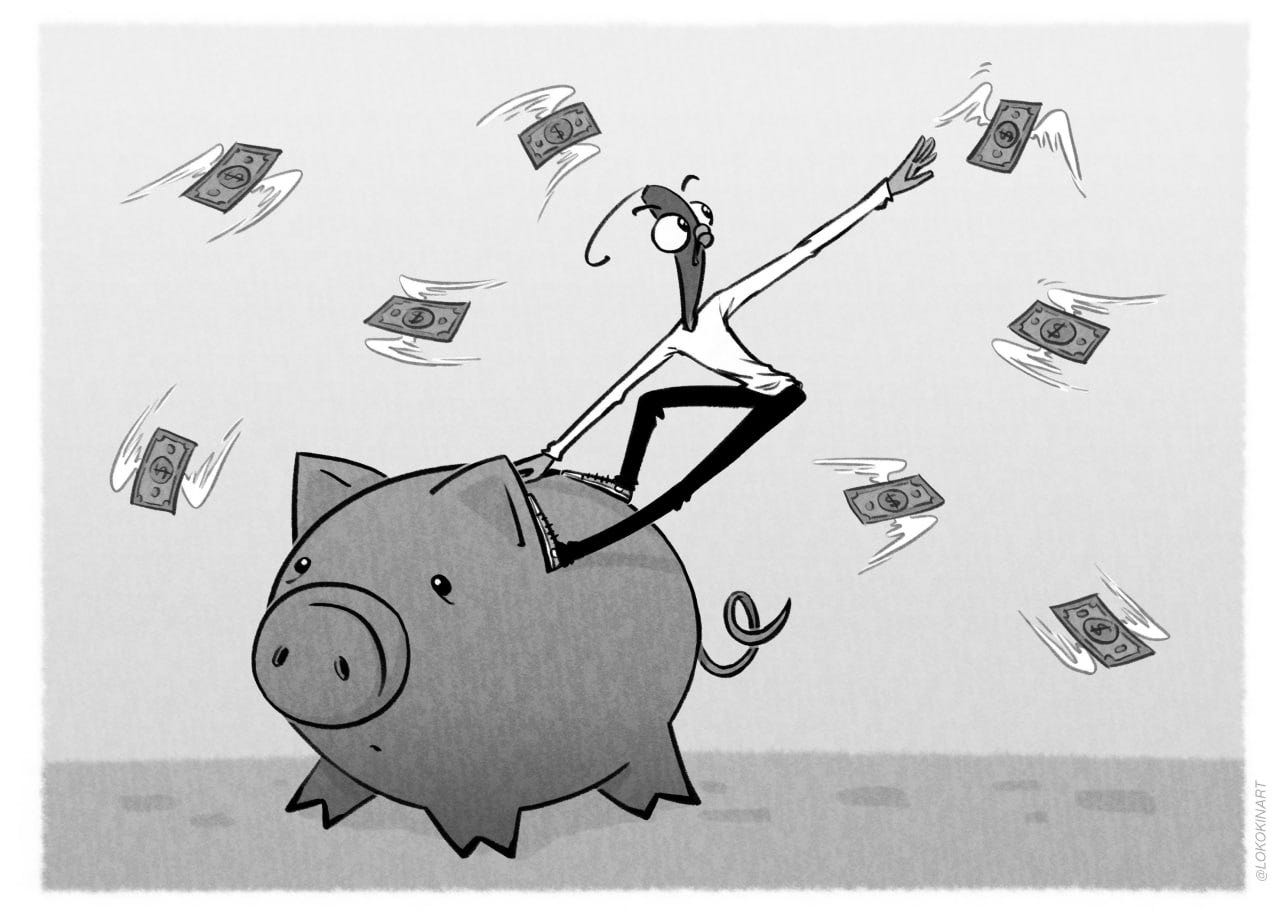
We have big plans. Plans need people. People need food. Food costs dollars. Dollars are like pandas. We keep trying to get them to fuck and make more, but they'd rather sit around and go extinct.
In January we had what folks in the finance world call zilch. So we launched a series of cockamamy schemes to fund Chill Subs.
One of those schemes was this, right here. Things We Do While Waiting To Die. This (kinda) startup diary where I shout nonsense at you every Thursday. Fun, right? We think so. it's full of opinion, humor, anecdotes, pictures, and guest essays.
Then, in May of this year, we had the idea to launch a second Substack called The Sub Club Newsletter. It's full of actionable no-bullshit information to help writers get published.
Our "gross annual income" from these Substacks has reached $30,000. That's a lot of happy pandas (with a load of caveats). We have learned a lot about what is more fun to write vs what is useful (i.e. what people engage with vs. what they pay for.)
So today I am going to do a full breakdown of both substacks with screenshots, unexpert analysis, and some shot-in-the-dark conclusions.
Here it goes.
The first thing we learned was that people rarely click to sign up for a paid subscription unless they think what follows will benefit them.
For example, let’s take a look at some stats from Things We Do While Waiting to Die (this Substack)
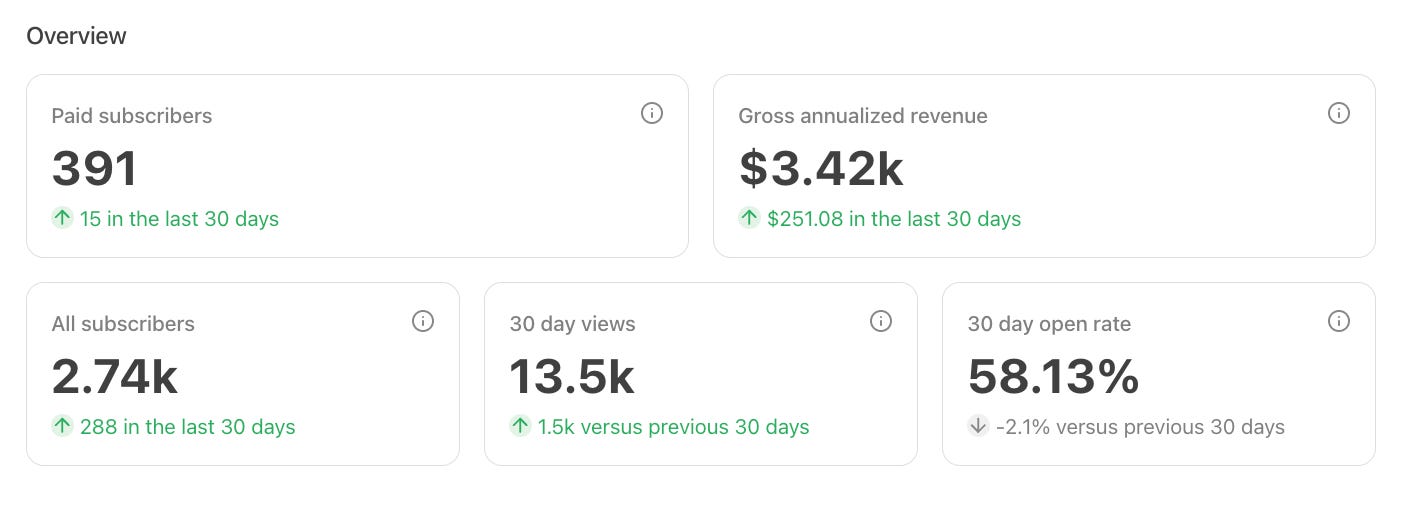
Those are our overall stats. Keep in mind that we comp anyone who asks or is a premium member on our website, so those paid subscriber numbers are skewed. Here, this is what that looks like:
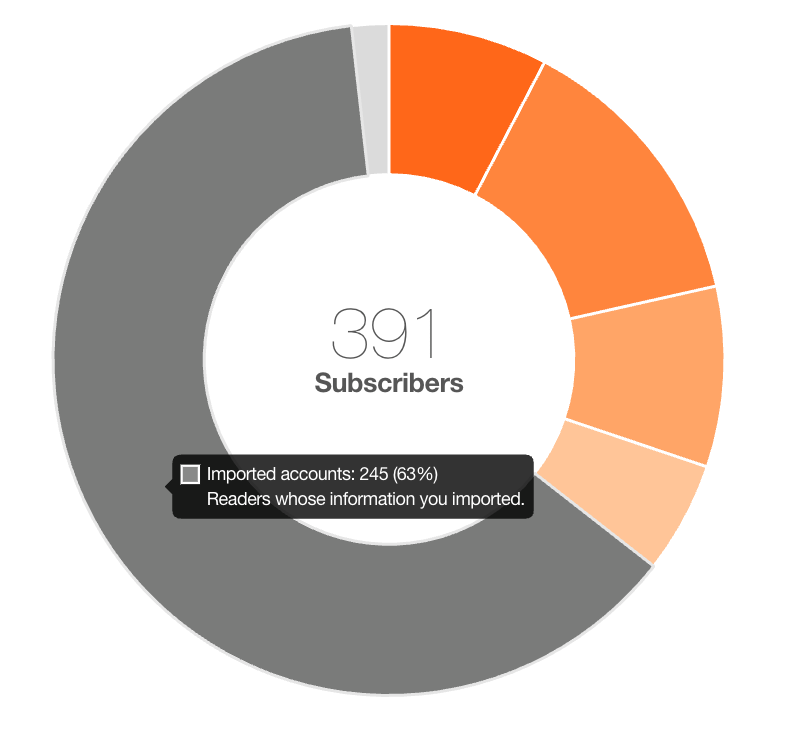
Still, this is not bad. We mainly provide some fun insights and entertainment here. Though, when you look at what drives these paid subscriptions, it becomes pretty damn clear:
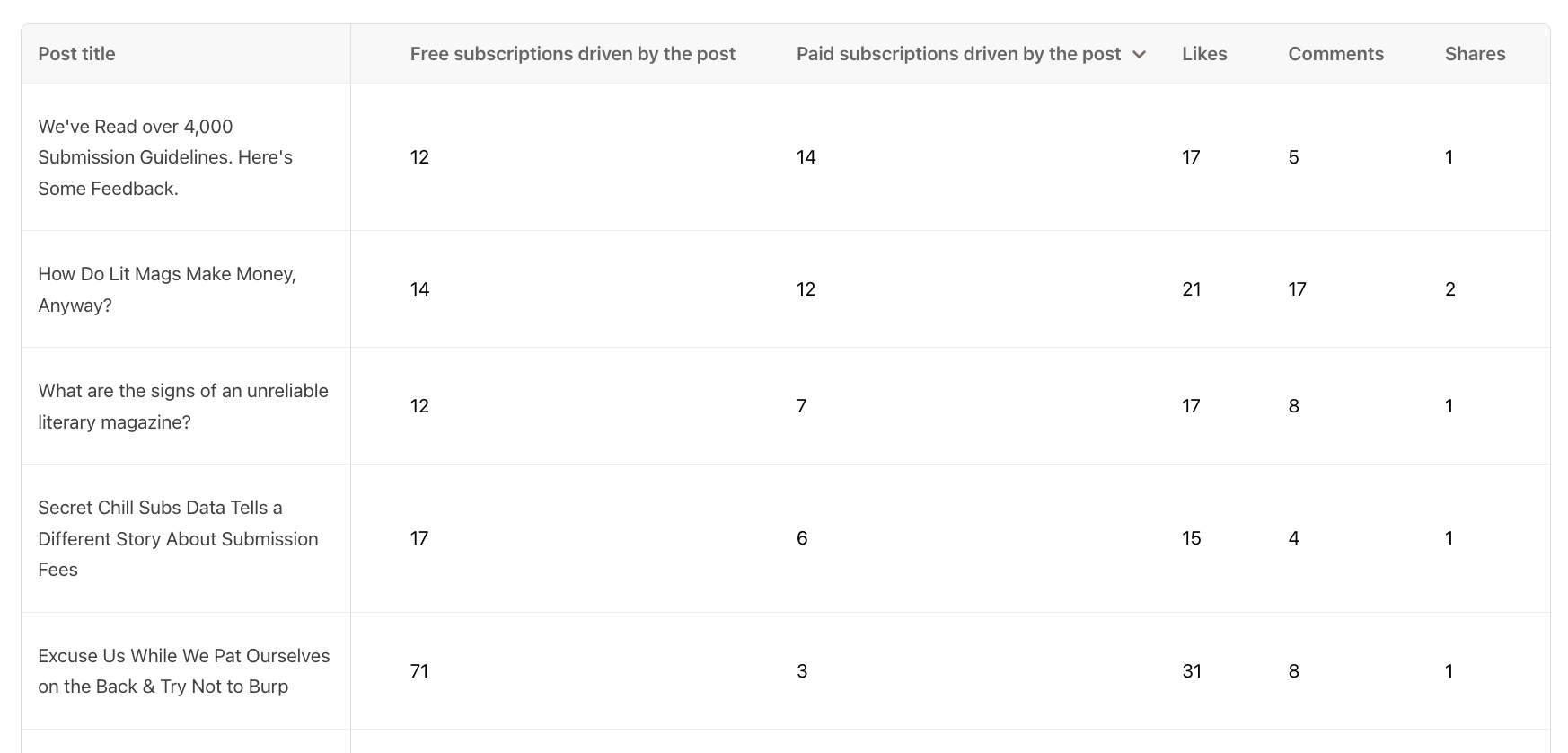
Those are the posts that gave us the most paid subscribers. Each one, aside from #5 (which was our first post ever) contains information that people want to know about the literary industry based on data only we can provide. Seems simple enough. If we wrote things like this all of the time, this newsletter would probably be much more profitable. But…we don’t particularly like writing this kind of thing. It takes days of research. And, what’s wild to us is that our audience doesn’t like them most either. I mean, look:
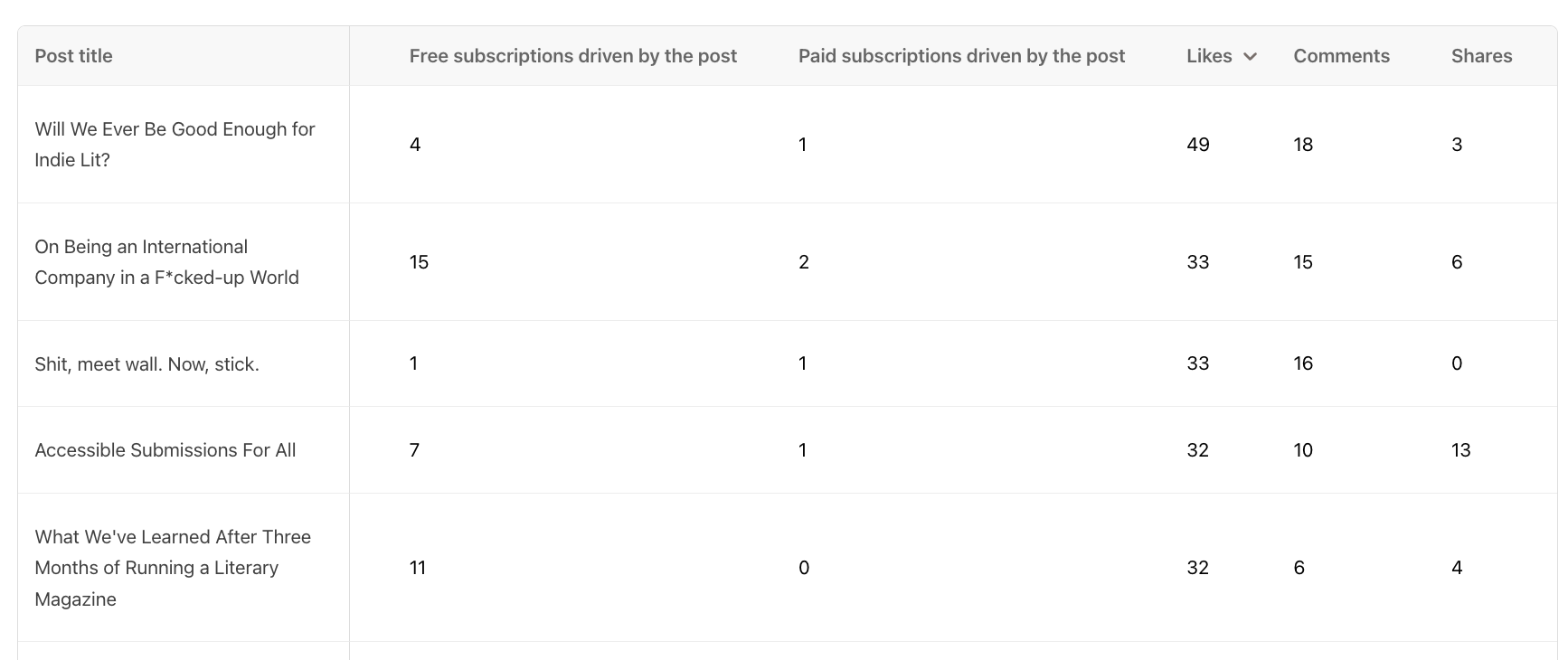
These are our most liked posts. They all have lots of engagement, likes, shares, and we loved writing them.
Did it drive paid subscriptions though? Nope. None of them have actionable information in them. Combined, they only netted 5. Now, that’s okay for me. This is a startup diary. It’s meant to be fun. We want people to enjoy the content, but people rarely pay for entertainment. This probably isn’t news, but even when you look at hugely profitable entertainment-focused substacks, they are mostly by already famous people. Even then, they give out tons of actionable freebies to keep paid subscribers.
I think this has made me quite skeptical of the idea that Substack can be profitable for individual bloggers just writing fun entertaining stuff. I think there always needs to be some element of usefulness for readers. There is so much free entertainment out there, it just doesn’t seem a sustainable shtick for substack. But who knows! Maybe we just aren’t funny enough. I guess, it irks me to see marketing campaigns for content platforms claiming that finally, FINALLY! writers will have a place they can make money! But every time, it’s the authoritative, actionable content that drives funds unless you’re established elsewhere.
This becomes more stark when you look at our Sub Club Newsletter. We designed this to be purely useful. Sure, I write some intros, we have guest posts on Fridays, but those intros are not what is causing this drastic difference:
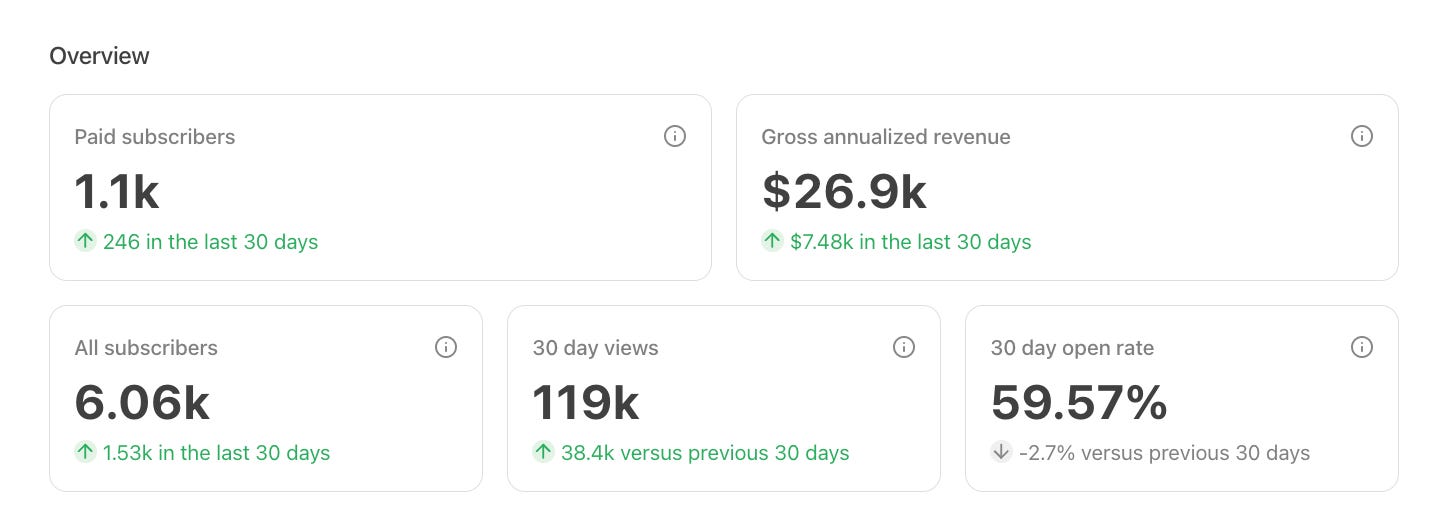
Remember, this newsletter has only been around since May. That’s four months after Things We Do While Waiting To Die. Nearly 120K views a month? Hell. Also, these paid subscriber counts are skewed similarly to the diary:
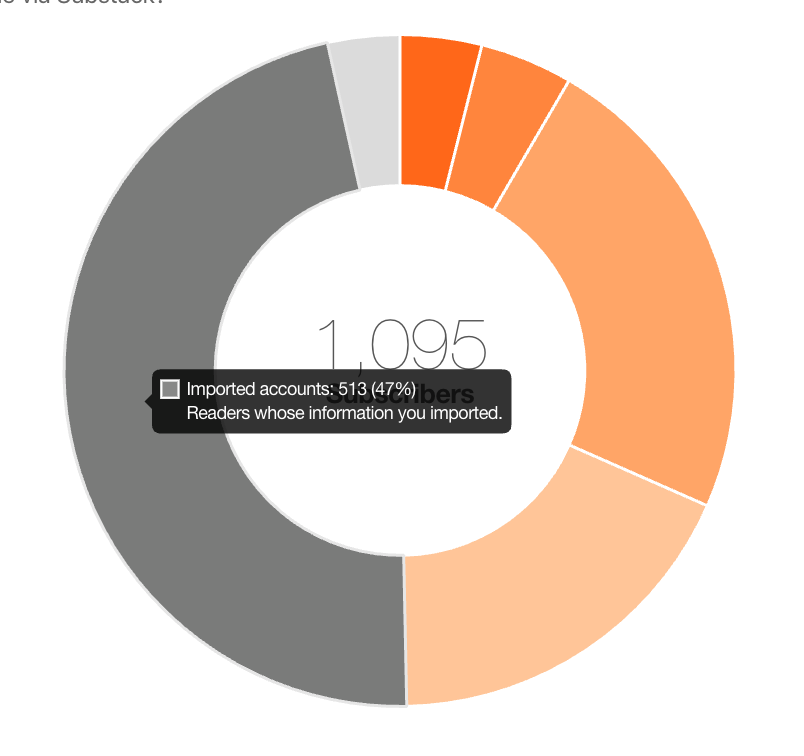
Still, that’s over 500 paid subscribers in six months with more than twice as many free subscribers.
Now, Substack takes a cut, and “Gross” income is a deceptive number. In our stripe, you can see exactly what this has earned for us:
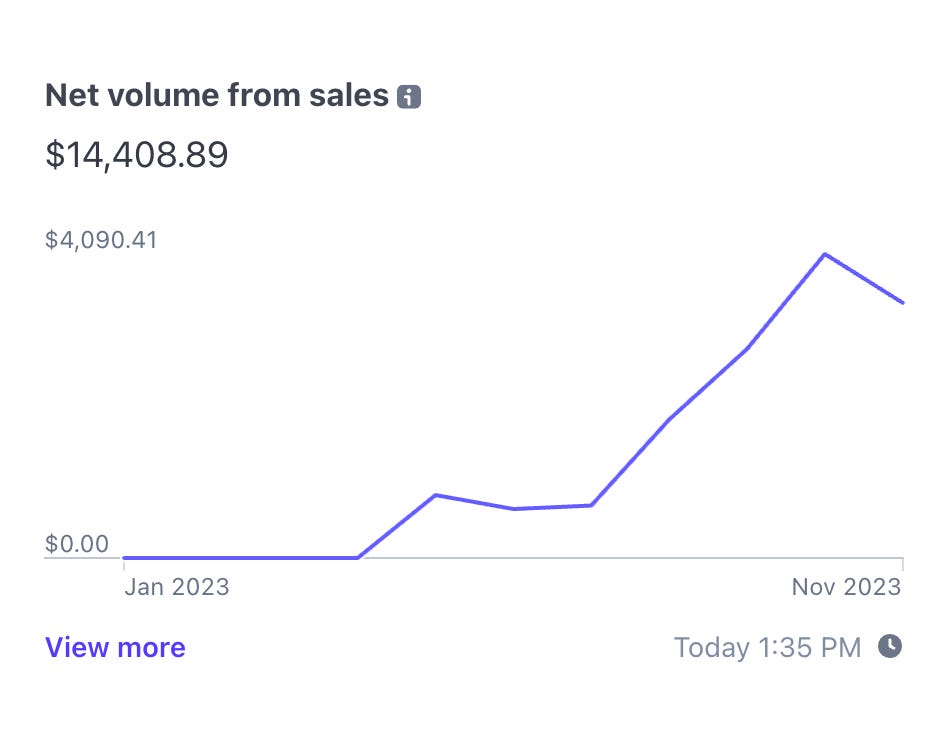
If I were alone writing this substack, in six months, that’s about a minimum wage job for one person. This is what is holding up 50% of our company. It takes 6 people full time to manage all that we do (plus several part time folks) six months, 6 people, that’s $400 per person.
So, with a website behind me, a large established following, and pure jet fuel for actionable data to work with, we’ve managed to afford to pay a single front-end developer. And yet, I think by any metric, this would be considered a successful first six months on Substack.
So, what can we learn from the road so far that points us in the right direction? OK, first, there is this:
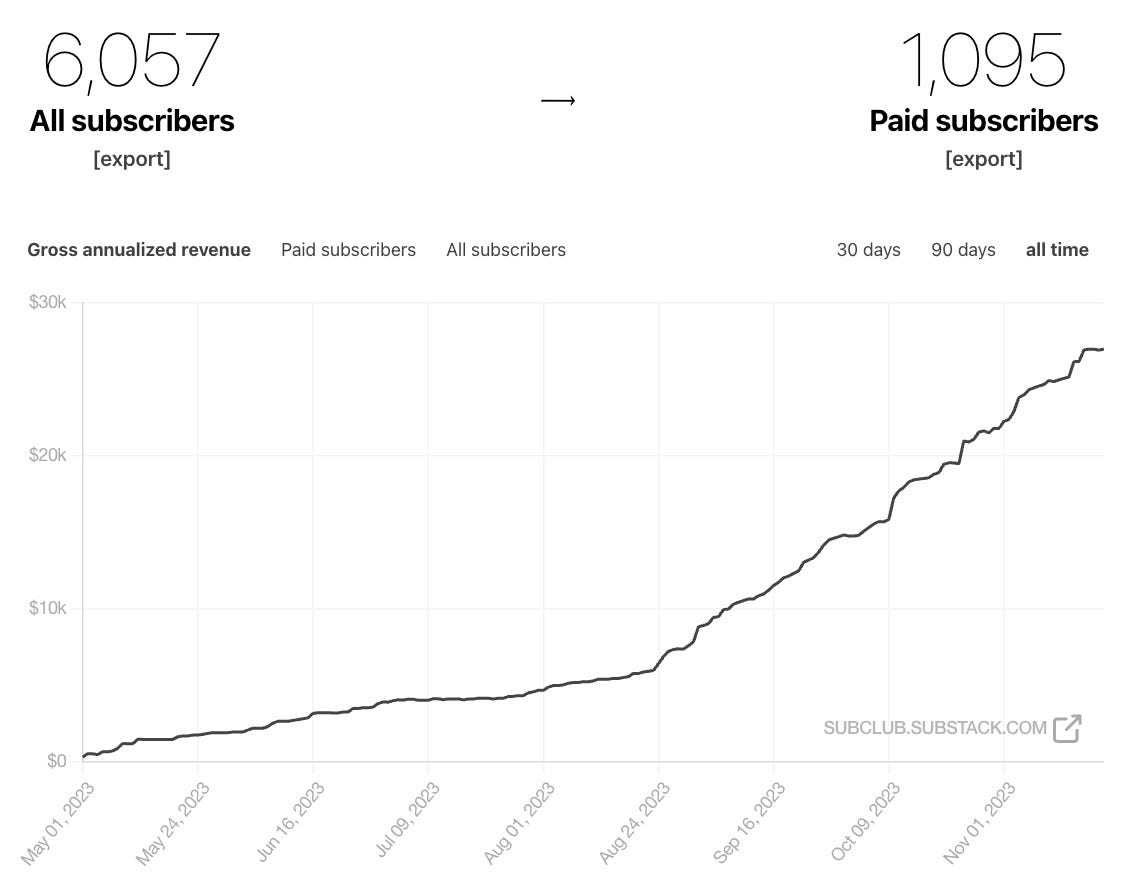
What the fuck happened in August?
Well, up until that point, we were doing a lot of fun funky community-oriented stuff. We had a sandwich theme, a lot of confusing puns, and tried to do a lot with different features, raffles, round ups, and whatnot.
In August, we realized that was not what people wanted. Or, more importantly, that’s not what people were paying for. People wanted information that would help them submit to magazines. So we rebranded, toned down the art, removed the puns, changed the descriptions everywhere to say exactly, simply, what we could offer people. And boom.
Our lives got easier. People were happier. We made a lot more money. Keep in mind, we also have offered endless comps to anyone who needs it. Around 100 of our “paid” subscribers are folks who just needed a helping hand.
Simple, actionable information with a clear message geared toward helping others succeeded where “fun” failed. But we want to write whacky anecdotes with cartoon characters dammit! We want sandwich puns and weird experiments.
People want that. Hell, they need that. But, in our experience, people are not lining up to pay for it.
There are other things to consider, of course. We publish 12 times a month on our Sub Club Newsletter but only 4 times here. We offer a lot more advice over there for people submitting. The advice and data-driven pieces here are more often geared toward editors.
I just…want it to not be this way. But can’t pretend I don’t do the same. With 100 Substacks out there I want to read, I’m going to pay for the ones that provide me with something useful. Hell, I have like 50 books waiting in queue on my kindle for me. I don’t need to pay for more content. I’m drenched in content.
On every metric, The Sub Club Newsletter crushes Things We Do While Waiting To Die.
Ooo! Except for subscribers generated by recommendations!
The Sub Club Newsletter:
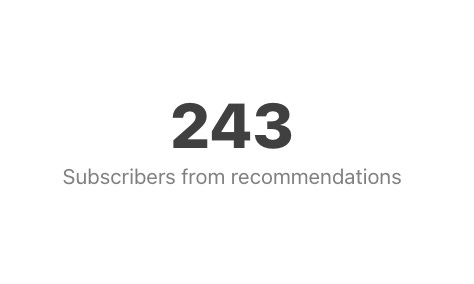
Things We Do While Waiting to Die:
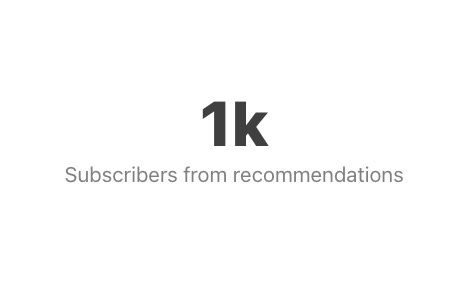
Ah, ffs…
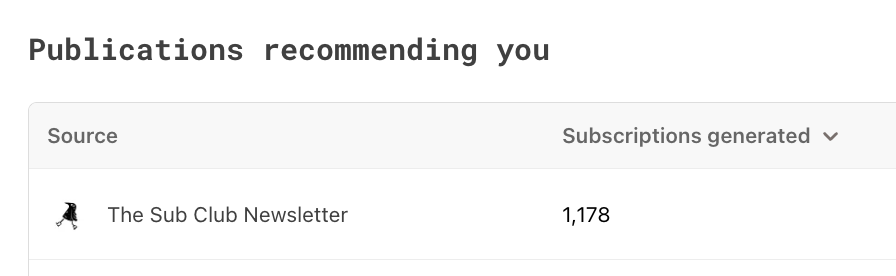
Okay, so what have we learned? Let’s take a look.
Mood Music for Pandas:
Find something useful to publish:
If you are going to launch a substack that is entertainment focused, make sure you have some element that provides actionable, useful information. Even if it is a weekly round-up, or some valuable insights about your niche from your perspective, it doesn’t matter. Do something like that. A lot of big newsletters I’ve seen often have a very popular section that is some sort of round-up or commentary.
Erik Hoel has his Desiderata round up, Emma Gannon has her Sunday Scrolls, and many more. (Gosh, detour for a minute. I just went and checked out loads of substacks in different categories to see what they do for round-ups and many-many of them have some variation of this like The Free Press has some Friday thing. But also…fuck, man. People suck. Just so much nasty fear bait out there, huh? woof. And commentary on the personal lives of famous people. Like, geez. Ick. I need a shower or something. I really just can’t do culture/political commentary stuff. Makes my insides cry.)
Okay, so Find some way to save people time and/or money.
I don’t think you need to be an expert to do this. I believe that the “endless entertainment” dilemma can work to people’s advantage. I think the internet is going to become more niche, more curated and it needs curators. I love movies. I’d pay for a substack about movies for their paid weekly round-up of mini-movie reviews, or industry gossip. I don’t need Brad Pitt to write it. It would save me time and energy narrowing down my choices.
So, get creative with your interests, paywall something that takes you a lot of time to create that others would love to spend their time doing but can’t because their too busy trying to get their own goddamn pandas to fuck.
Learn from successful people:
I read a lot of big substacks simply to learn from what they do. One of my favorites for this is Emma Gannon. Another is Erik Hoel. I look for how they present sales, where they put their calls to action, how much they engage using substack’s features. That was a big thing that I learned from Emma Gannon. I started posting a lot on notes. And you know? Wasn’t great. But it helped. Every little bit helps and the more I’ve done it, the more it helps.
I’ve also learned from the opposite. Whenever I unsubscribe from something, I ask myself why I unsubscribed. I won’t pick on any examples for this but the main reason is because they didn’t provide me with enough useful content to justify the cost. It’s that simple. Speaking of…
Keep it simple and consistent:
Whenever we’ve tried to get creative with things, it hasn’t gone super well. I think it becomes a bit like chasing a high. Something is working and when it does, it kicks your subscriber count higher and higher and you want to do that again, so you try something else. But why? If something is working, milk it. Don’t try to do too much. I think we had like 17 different things going on when we started The Sub Club Newsletter, now we have, like 4, and its a solid 4. People know what they’re getting, what their paying for, same time, same days, and aren’t getting some random one-paragraph shout-out on a Sunday morning about signing up for a gift basket exchange or something. I’m shit at taking my own advice but over-and-over I have to remind myself, “do less, better.”
Be kind
OK, I’ll never get people to agree with me on this, but I’ll die on the hill that you should leave a door open for people who need it. Technically, we lose $500/m because we give away subscriptions. Would those people pay if we didn’t have that option? Maybe. All of them? Probably not. I’d say we’re losing half to people who might be able to afford it if they would just muster up the courage to kick their cousin off their Netflix account. But one consistent piece of advice I see from creators is to ruthlessly paywall all or most content. I do see the logic. I just disagree. I also don’t have any children to feed though so hey, this is just my opinion as someone who has been in a position where $5 was a lot of money to me.
I don’t think there is a trick
Every writing platform I’ve been on is full of super-successful people sharing loads of tips, tricks, advice, secrets, blah-blah-blah for success. Here’s the secret: they are making money selling mostly common sense and bullshit. You are the secret. You, paying them for advice about how to sucker people like you. Even this post is kinda some bullshit. Our situation is so specific that I can try to pull helpful insights from it, but is it repeatable? I have no idea.
I don’t think it matters where you put the paywall, or how you phrase your call to action. I’ve tried a half dozen different calls to action, and it never makes a difference. If the information is valuable, people pay for it. Hell, in one post Shel suggested we make the call to action “SMASH THAT SHIT” and there was no discernible difference.
I used to work in PR and my bosses paid loads to a consultant who came in and said, “for the best results, publish at 9:11 AM in New York.” And they frantically made us come in earlier every day to make sure it happened. But no matter when anything posted, what did well was whatever had valuable information that happened to get picked up by the algorithm that day. Maybe it matters for huge companies where a .05% difference is a lot of money. But for most people, the time spent learning these random “tricks” is time spent not getting better at whatever you’re trying to create. I really think that as creators we get caught up in programs and subscriptions offering tips and tricks when all it comes down to is a lot of luck, effort, and refusing to let those pandas lay down and die.
"But is it repeatable?" -- that is the question of the day. Exactly. Just because blogger X does something successfully does most assuredly NOT mean that no-name me can reap the same or even similar rewards from doing the same shtick. Also, your closing line about "a lot of luck, effort and refusing to let the pandas...die" is bang on. Persistence and self-belief (or at least more self belief than self doubt) will get me further than if I do nothing. Just exactly what success looks like for me in my writing life depends quite a lot on the state of the larger world, the contents of my fridge, and how recently I have seen the sun shine through my windows. By which I mean, success is fickle but my desk and my laptop are always (t)here, waiting for me to do what I enjoy: putting words together into something that I hope will be read by some reader(s) somewhere. To reach that reader/those readers, I must first write, then post. And then repeat. Tomorrow, and tomorrow, and tomorrow...
I love the transparency you provide here. So helpful, and I wish more people/orgs were willing to do that.
I also appreciate what you said about posts that are successful but take a lot of time from you and that you don’t enjoy writing. I don’t think anything you don’t enjoy doing most of the time can be sustainable.
Thanks for continuing to put content like this out there!