

We had a staff change in August. Our database person has left to start a hiking business. When he left, we asked for his feedback on our data. Specifically, we asked if he’d seen any trends that might indicate whether a magazine is likely to go defunct.
I’ve considered writing about this for a while but as someone who has been an editor and writer for a long time, I think my insights would be skewed by the on-hand excuses I'd make. And I’d feel like I was making unfair accusations. I guess you could call it professional empathy.
So, I asked him for his thoughts. He has been reviewing over 3000 magazines daily for the last 8 months. He is not a writer. Pure data driven observations. I'm sharing them for writers who might be curious, and editors who might want to know what the data says.
Please understand that these are insights from reviewing over 3,000 magazines and not a list of definite warning signs. For example, one of his claims is that magazines are more likely to go defunct that have been founded within 3 years. That isn't to say, "Don't submit to new magazines!" but simply one indicator that more research should be done before submitting. Most of my favorite magazines have been founded in the past three years.
In total, he identified four factors that stood out most that contributed to a magazine having a greater likelihood of going defunct.
Here are the four factors he mentioned:
No masthead
No unique URL (i.e. Wix, WordPress, Blogspot, Weebly, etc. is in the URL)
No clear reading periods
Founded in the last 3 years
I took everything he said and applied our data to see if his claims could be backed up.
Since we were founded in January of last year, 138 magazines have gone defunct or been abandoned. As of writing, there are 2969 active magazines in our database. We have roughly 200 that are currently on hiatus, have expired calls, or are not confirmed as “dead.” I left those out so the comparison would be more clearly defined between active/defunct.
Claim # 1: a magazine with no masthead is likelier to go defunct or get abandoned.
The data says: TRUE. Of the 2969 active magazines in our database, 340 have no masthead. That is 11.4% of magazines.
For defunct magazines, that rises quite significantly to 26.8% (37 out of 138).
In this case, a magazine without a masthead is 2.35x more likely to go defunct.
Claim # 2: a magazine that has no unique domain (i.e. Wix, WordPress, Blogspot, Weebly, etc. is in the URL) is likelier to get abandoned or go defunct.
The data says: TRUE. Here, there is an equally significant difference between active and defunct magazines with the URL for defunct magazines at 20.1% (28 of 138) and for active magazines at 7.6% (227 of 2969).
This is where my knee-jerk defenses come in to say that hosting a magazine costs money and many small magazines are labors of love with no budget. Sadly, it is what it is.
In this case, a magazine is 2.65x more likely to go defunct.
Claim # 3: a magazine that doesn’t provide clear submission calls is likelier to get abandoned or go defunct.
This claim was, far and away, the most accurate indicator of a magazine’s unreliability. Though fairly common among active magazines (1335 of 2969 or 45%), it was nothing compared to the consistency with which magazines destined to go defunct did not clarify their reading periods: 136/138 or 98.5%
And in this case, a magazine is 2.19x more likely to go defunct. However, it's worth noting that while the multiplicative factor is lower in this case than the previous claims, the sheer disparity in the percentages (45% vs. 98.5%) highlights just how significant an indicator this is of a magazine's potential unreliability.
In simpler terms, while a magazine that doesn’t provide clear submission calls is "only" about 2.19 times more likely to go defunct, nearly every defunct magazine (98.5%) had this characteristic, making it a very strong indicator of unreliability.
Claim # 4: A magazine founded less than 3 years ago is likelier to go defunct.
This claim was the least weighty of the four. It is true that 44% (61 of 138) of defunct magazines were founded in the past 3 years, and 35% (1043 of 2969) of active magazines were also founded in the past 3 years.
I don’t think this is a literary problem as much as it is the way things are with anything. People are more likely to drop something they haven’t invested much time or money into.
Based on these observations, it’s no wonder magazines founded in the past 3 years are only 1.257x more likely to go defunct.
When he first told me these observations, I thought, “Hey wait a minute, I love Jellyfish Review, and they didn’t have a unique domain!” They went defunct. Then I thought, Okay, well Muskeg was a nice place even though they didn’t have a masthead. They went defunct.
I think that all of these have something in common. They all have to do with commitment. If you don’t list your name on a masthead, no one can hold you accountable if life gets in the way. If you don’t pay for web hosting, have you really lost anything? And if you don’t promise certain reading periods, there is nobody to disappoint if you let the year coast by without ever opening up. And it makes sense that if you haven’t gained any traction within a few years, you aren’t hurting too many people when you throw in the towel.
None of these factors cause a magazine to go defunct. That has more to do with the founders of a magazine than it does with any single factor. But, based on these observations, writers can make a fairly informed decision when deciding where to submit their work.
But do writers even care? And, if so, how much? If an editor is on a shoe-string budget who has to make a choice between investing time into their guidelines, or money into their domain and design, what to choose? Well, we took these factors and asked our community on Twitter to tell us their thoughts.
We ended up with a little over 300 votes. You can see the results here.
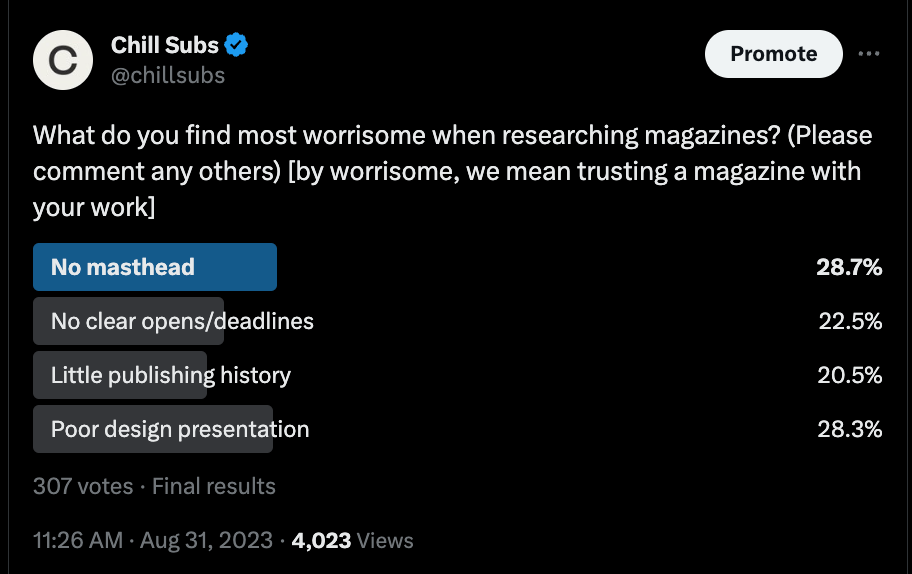
While it came out surprisingly even, No Masthead came out on top. Out of all these factors, I do feel it is the most indicative of an unreliable magazine.
There are only a couple honest reasons I can think of why a person wouldn’t put a masthead. First, they feel they are too young/inexperienced to run a literary magazine.
But here is the thing, if you submit to any University Affiliated mega-awesome top-tier magazine, most likely an 18-21 year old is reading your story first. So, that is simply a reality of indie lit. I’ve read enough brilliant work by young writers to have no problem with this.
And second, they don’t want to reveal where their magazine is based or the home country of the person who is running it.
To this, I’d say, if someone is not submitting to a magazine because of judgments around where it is based, that is at best xenophobic. At worst, racist. So, who would want to publish someone like that anyway?
But the most pernicious trend we see when a magazine doesn’t have a masthead is money. Too many have high fees or run big contests. No masthead means no accountability. So if someone is looking to scam writers out of money, and we have no standard for transparency, it will attract bad actors. We get reports all the time of some magazine or another running a contest that never has a winner. Or announced a winner, then never published the issue. Or collected loads of fees, then went defunct. More often than not, no masthead.
This is the point where it’s easy to get all judgey and conspiratorial. I try to never think like that. I like to believe most people are good and probably forgot or didn’t see the relevance of these factors. So here is the simple truth.
Writers care. These factors (especially no masthead), whether nefarious or not, give off an impression. Just as our database person got the sense that these factors were strong indicators of unreliability, so will writers.
With heaps of appreciation and immoderate applause for CHILL SUBS in the first part of my sentence, I never mean to sound like an ingrate, Ben.
Just voicing frustration with the worst offenders - - the fake contest presses [Midnight Oil, et al].
I realize the literary landscape changes so fast that even a team of a three dozen could not keep up.
A badge system with "warning labels" would be excellent.
How about a SKUNK for the worst offenders?
There's another issue all poets and writers should be aware of:
* * Oftentimes a defunct journal or an indie press will go defunct, yet still appear in Submittable.
* * Their fee-driven "contests" will still be recycled, year after year, in Submittable.
Especially if a contest FEE is involved, do your homework by going to the website and check the dates of the last books they published (and how many books were published).
. . .
Sometimes scam artists seem legit - - and the website still seems current when you submit.
I've been scammed out of a $20 submission fee by Midnight Oil when I submitted a chapbook for their contest that was supposed to be "judged by November 2022."
Midnight Oil did not look defunct at the time.
However, Midnight Oil does not reply to emails - - and Chill Subs and others continue to list it in their database.