

There are a lot of reasons writers submit to literary magazines. Rather than cram each one into this piece, I narrowed my focus to one of the most common reasons. I’ll do a part 2 at a later date to focus on the fun/social aspect of submitting. For now, I hope this offers some insights. If you like the work we do, you can support us by becoming a member or paid subscriber.
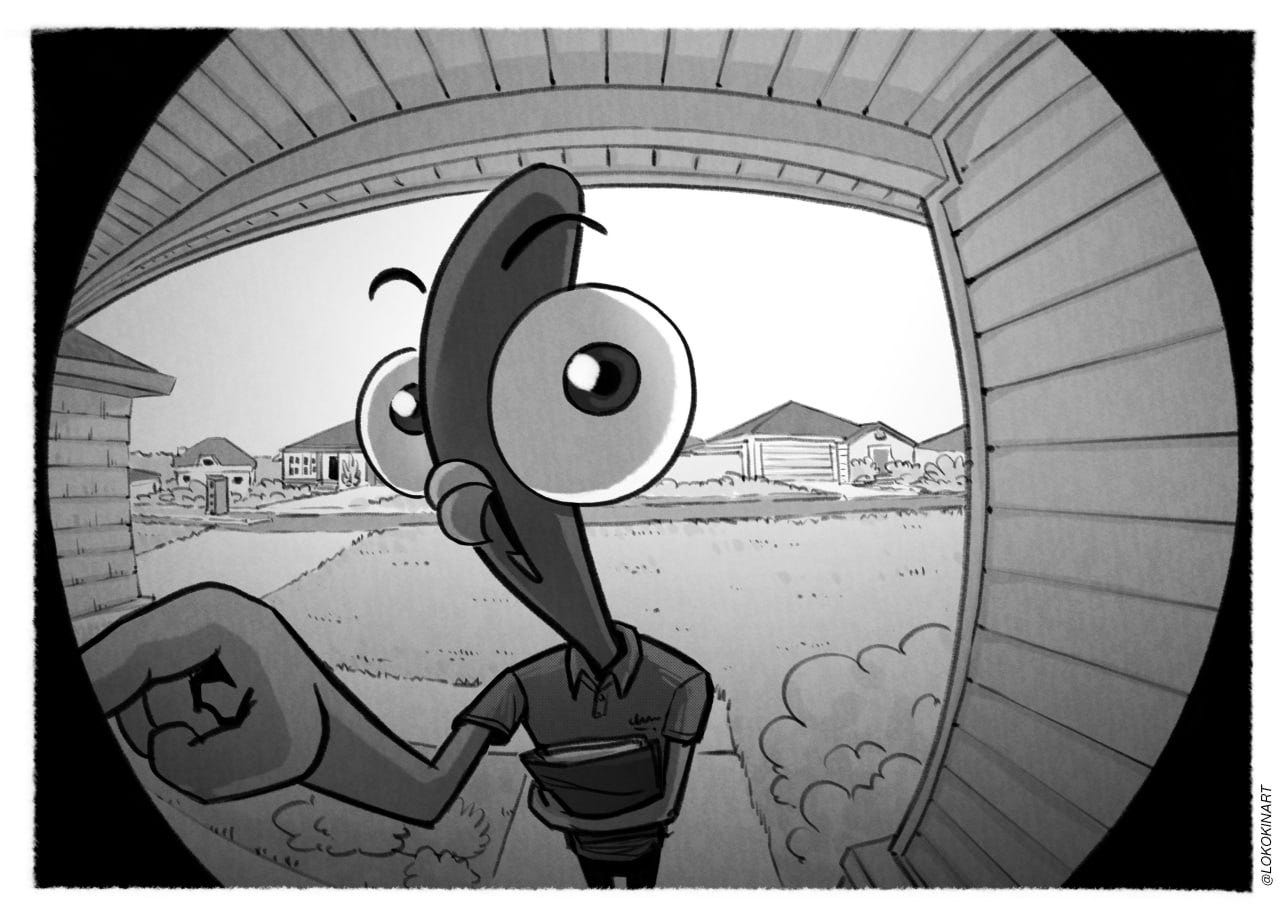
From 2011-2013 I worked as a door-to-door fundraiser for nonprofits. Each day we were given “Turf” — a spliced-up neighborhood of doors to knock on until someone opened, and I could vomit my script all over them. It was a fun job. Most people slammed the door. Enough didn’t. I spent three summers doing this.
One day, I knocked on the door of John Katzenbach, the psychological thriller novelist best known for a movie adaptation of one of his books called ‘Hart’s War.’
I started in with my spiel, “Hi, my name is Ben, I am from [INSERT NONPROFIT], did you know [INSERT SOMETHING HORRIFYING]…”
But John (can I call him John?) cut me off. He said he always gives money when we come around. (Those were the best doors to knock on.) While he was filling out the check, he asked, “So are you planning to go into nonprofit work?”
“No,” I said. “I want to be a writer. So I guess I’ll be broke forever.”
He smiled and said, “I’m a writer.” Then he casually waved at his house. It was a fuck-you-money-sized house. Then he said, “My wife is a writer, too.” And Pulitzer Prize-winning journalist Madeleine Blais walked over from the living room.
“I’ll tell you a secret,” he said, “Never let anyone read your work who doesn’t love you or want to profit off of you.”
Madeleine (can I call her Madeleine?) nodded.
They gave me $200.
I tried to follow their advice. I truly-truly did. But when I submitted my first story to a magazine in 2014, I only wanted one thing. I wanted somebody, anybody, to tell me I was good. Sorry, John.
I think this is one of the first, if not most common, reasons people start to submit to magazines. Growing up, my mother was a waitress. My father was an insurance underwriter. I knew nothing. To my mind, writers were born or found. They were like diamonds. These things just laying around that, when discovered, were immediately acknowledged as having value. Seemed a simple process: write a story, publish it in literally any magazine, and the world would turn and go, “Oh, hey there genius! We’ve been looking for you.”
That is not, you might imagine, how it went. Here is my first rejection letter:
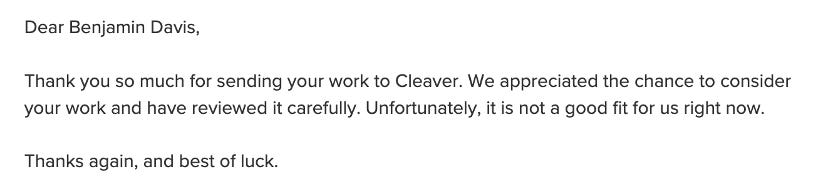
A diamond, I was not.
Looking back now, after several years of submitting, I think John & Madeline might not have given me the whole story. In retrospect, I should have known. In retrospect, I was nineteen and slinging nonprofit scripts for beer money. It wasn't until I read On Writing by Stephen King that I remembered my little conversation with John & Madeline. Steve (my dad's name is Steve, so I think I can call him Steve) referenced John's dialog writing chops:
I don’t know if contemporary novelist John Katzenbach is a loner or not, but his novel Hart’s War contains some memorably bad dialogue. Katzenbach is the sort of novelist who drives creative-writing teachers mad, a wonderful storyteller whose art is marred by self-repetition (a fault which is curable) and an ear for talk that is pure tin (a fault which probably isn’t).
Oof. Damn, Steve. But it's always nice to see someone more successful than me get slagged on. More than that, though. I'd never met an author besides John. He was not a mythical diamond to me. He was a kind, generous guy with a successful career. And there he was, getting gently dragged through the mud in one of the most popular craft books of all time tucked between anecdotes about cocaine-fueled binge-writing.
So I started rethinking my diamond theory. Maybe being a writer has less to do with writing than people think. Maybe it has less to do with, "only showing it to those who want to profit off of you." Maybe, it has more to do with first proving you are profitable.
John Katzenbach didn't publish his first book until he was 32. Madeline Blais didn't publish her first book until well into her forties. What were they doing that whole time?! Were they sitting around at home writing brilliance then sending it over and over only to people who would want to profit off of them? (Well, if you asked Stephen King, at least part of that isn't true.)
And no, of course, they weren't.
Both Madeline & John made their mark first by working as journalists. They slogged through assignments, made connections, wrote stuff I'm sure they hated. Hell John worked as a court reporter. Fuck that. But they got better, and better, made connections, won prizes, and then crawled out of writer purgatory into a nice old house in Amherst, MA as successful authors.
The internet has more-or-less demolished this path to success, but equivalencies exist. Submitting writing, getting published, making connections, are as much a part of writing (if not more so) than the writing itself. This has been proven time and time again. If you look at writers throughout history. Connections matter. Nailing your writing to the door of places that publish over and over and over is how it works. Or, working within an industry. Becoming a reader, an editor, a teacher.1
We recently did a poll to the writers in our community and found the top reason people submit was for ‘literary credibility.’ Connections, recognition, community. Writing is a grind. Submitting is a grind. Getting published creates opportunities.
The path to a writing career in the age of the internet doesn’t only mean taking a writing-centric job (as John & Madeline did), or doing a clown car full of cocaine (like Steve did).
It means a lot more than being good at writing, or only sending your work to this type person or that. It means small steps, over and over. And these days, if you don't have the money for grad school, NYC-life, or cocaine, those steps come in the form of literary magazines.
And, let’s face it, with so much writing on the internet these days, the whole “maybe people will find my brilliance after I die” shtick is not likely anymore.
this a comment to compliment Ben’s writing
Totally agree with this: "It means small steps, over and over."